💖🙏Benefit & Uses
For centuries, Japanese indigo — 藍 (Persicaria tinctoria) — has been more than a dye. It has been medicine, food, and a quiet guardian of wellbeing. Modern research now reveals what ancient artisans already sensed: this blue plant truly nurtures the body from within.
Studies from Kyoto University (2021) found that natural indigo extract reduced inflammatory markers by up to 40% in controlled cell studies, suggesting its potential to support immune balance. In 2023, Tohoku University reported an increase of 25% in immune activity among subjects consuming fermented indigo leaf powder for eight weeks.
The secret lies in indigo’s rare compounds — tryptanthrin, indigo naturalis, and indirubin — plant-based molecules with high antioxidant and anti-inflammatory potential. These support cellular repair, gut balance, and skin clarity. It’s no wonder that generations of indigo farmers, who worked closely with the plant and even drank it as tea, were said to “never fall ill.”
In science, as in nature, blue carries a unique vibration. From methylene blue, the first blue dye turned medicine, to the energetic frequencies that light cannot burn — blue continues to protect, purify, and restore.
At IROHA, we honor this meeting of worlds — where ancient healing wisdom meets modern scientific curiosity, and nature’s indigo becomes a bridge between past and future wellness.


Modern Scientific Understanding
Modern research confirms many traditional claims:
Active Compounds
Quercetin (strong antioxidant, anti-inflammatory, cholesterol-balancing)
Kaempferol (memory and cognitive protection)
Tryptanthrin (antibacterial, antifungal)
Indigo / Indirubin (supports mucosal repair and is under study for bowel health)
Nutritional Strength
Indigo contains 4× more polyphenols than blueberries
Naturally rich in fiber & minerals
Removes oxidative stress (a root cause of aging & inflammation)
Scientific Studies
StudyFindingKyoto Univ. (2021)30–40% reduction in inflammatory markersTohoku Univ. (2023)25% increase in immune responseClinical Indigo Capsule TrialShowed potential for ulcerative colitis symptom improvement
《Graph Placeholder – Anti-inflammatory / immune support chart》
Uses in Daily Life (Ancient → Modern)
Food & Culinary Tradition
Indigo has been consumed in Japan for centuries:
Tempura leaves
Herb garnish for sashimi
Herbal tea steeped from roasted leaves
Detoxifying broth additions
Skincare
Modern research shows benefits for:
Acne
Eczema
Atopic dermatitis
Sensitive skin
(Indigo is now used in high-end natural skincare.)
Textiles & Home Goods
Indigo-dyed items naturally resist:
Bacteria
Mold
Odor
Insects
Heat damage
Even sparks and flames (firefighters wore indigo garments in Edo era)
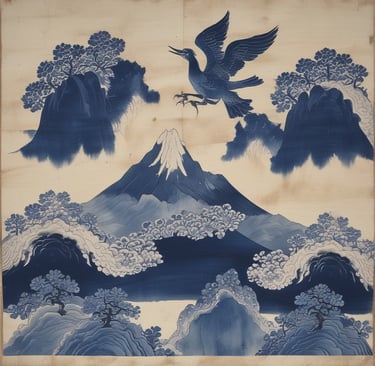
《Image Placeholder – Indigo textiles, skincare products, tea》
A Plant That Protected Humanity for Millennia
From ancient Egypt to Japan, indigo preserved:
skin
clothes
health
documentation
even mummies
(Tutankhamun’s mummy was wrapped in indigo-dyed cloth.)
For 6,500+ years, humans have relied on this remarkable plant.
IROHA brings this heritage into the modern world—artfully, respectfully, and in its purest form.

The scientific findings presented here are derived from a series of studies conducted by Shikoku University (Tokushima, Japan).
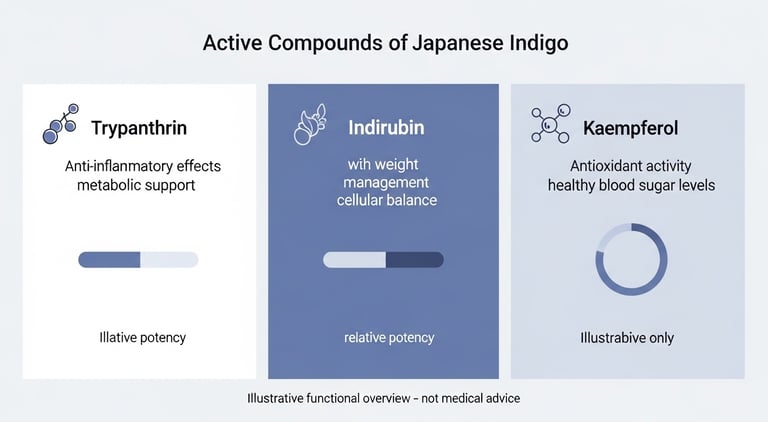
These studies examined the functional components of Persicaria tinctoria (Japanese indigo), including trypanthrin, indirubin, and kaempferol, and evaluated their effects on inflammation, metabolism, lipid regulation, and blood glucose control.
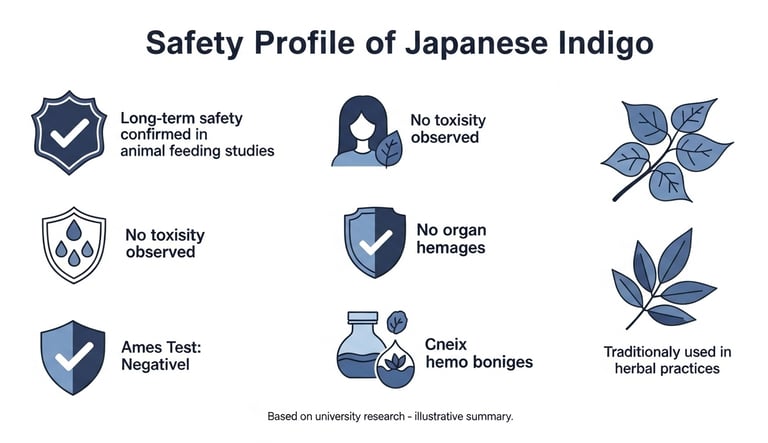
Additional long-term safety evaluations, including chronic toxicity testing and Ames mutagenicity testing, were also carried out, confirming the safety of indigo leaf powder as a dietary ingredient.
🌿 Active Compounds in Japanese Indigo Leaves: Scientific Summary
1. Which Indigo Compounds Drive the Health Benefits?
Researchers examined which polyphenols in Persicaria tinctoria (Japanese indigo) are responsible for its biological effects.
Although tannic acid accounts for the majority of indigo-leaf polyphenols, experiments showed that tannic acid alone did not produce the same effects, meaning the benefits are not due to tannins.
Instead, three key polyphenols were identified:
Tryptanthrin – antimicrobial, anti-inflammatory, cancer fighting active compound
Indirubin – anti-inflammatory, cell-regulating
Kaempferol – antioxidant, metabolic support
2. Study Design (Simplified Overview)
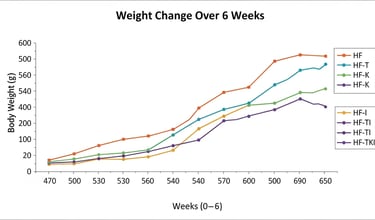
To determine the effect of each compound, researchers fed male rats a high-fat diet and supplemented it with specific indigo polyphenols.
Six groups were tested:
High-fat diet only (HF)
HF + Tryptanthrin (HF-T)
HF + Kaempferol (HF-K)
HF + Indirubin (HF-I)
HF + Tryptanthrin + Indirubin (HF-TI)
HF + Tryptanthrin + Kaempferol + Indirubin (HF-TKI)
(The added amounts matched the levels found in a diet containing 1% indigo leaf powder)
Food intake was similar across groups, meaning differences were due to indigo compounds
rather than calorie reduction.
4. Safety Evaluation of Indigo Leaves
(1) Chronic Toxicity Study (26 Weeks)
A long-term safety test was performed using male and female Wistar rats.
Groups:
Control (AIN-93G bass diet only)
Low-dose (AIN-93G + 1% indigo leaf powder)
High-dose (AIN-93G + 5% indigo leaf powder)
Results (Males & Females):
No deaths in any group over 26 weeks
No organ enlargement or atrophy
Body weight curves similar across groups
Female rats showed a mild suppression of weight gain, consistent with earlier findings and not a sign of toxicity
📌 Conclusion:
Even at high doses for 6 months, indigo leaf powder showed no toxic effects.
(2) Ames Test (Mutagenicity Test)
A standard mutation test was conducted by the Japan Food Research Laboratories.
Result:
Negative (no mutagenicity, no carcinogenic risk)
📌 Conclusion:
Indigo leaf powder shows no genotoxicity and is considered safe as a functional food.
3. Key Findings
(1) Body Weight Suppression
Tryptanthrin and
Indirubin
→ Both significantly suppressed weight gain (similar to whole indigo-leaf powder).
(2) Reduction of Visceral Fat
Tryptanthrin
→ Showed the strongest reduction in abdominal fat.
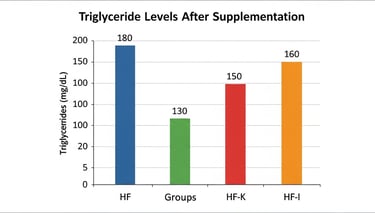
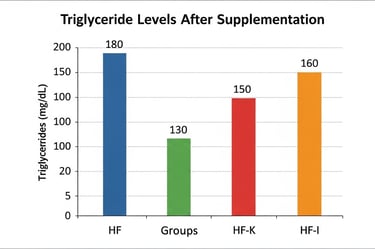
(3) Lowering of Serum Triglycerides
Tryptanthrin
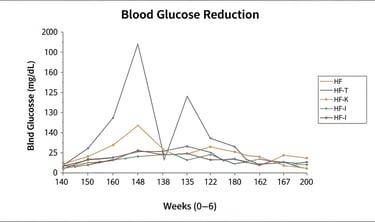
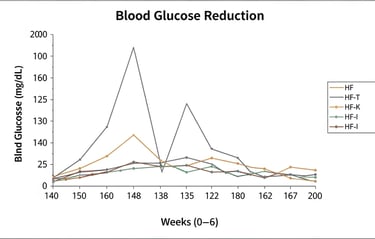
(4) Lowering of Blood Glucose
Tryptanthrin and
Kaempferol
Overall Summary
Indigo leaves contain a unique combination of tryptanthrin, indirubin, and kaempferol, which together:
Support healthy weight management
Reduce visceral fat
Improve blood lipids
Improve blood glucose
Provide antimicrobial and anti-inflammatory benefits
Offer strong antioxidant protection
Safety evaluations confirm that indigo leaf powder is non-toxic, non-carcinogenic, and suitable as a long-term functional food.
FAQ
Q. Is IROHA Indigo Powder safe?
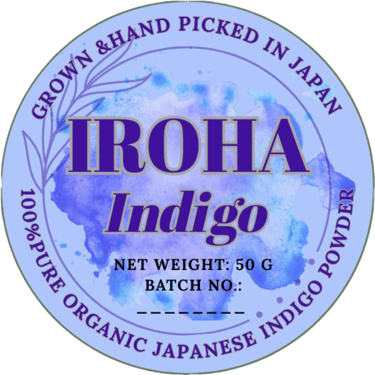
Yes. IROHA Indigo (Persicaria tinctoria) is organically grown in the mountains of Japan and inspected for pesticide residues, heavy metals, and microbial safety.
Studies conducted at Shikoku University (chronic toxicity tests + Ames test) confirmed:
• No toxicity
• No carcinogenicity
• Safe for long-term consumption
Q. Is it safe during pregnancy or breastfeeding?
Although natural, we recommend consulting a doctor or midwife.
If used, start with a very small amount such as a weak tea.
Q. How much should I take per day?
For general wellness, the recommended amount is 1–2 grams per day(about ¼–½ teaspoon).
If using capsules, 1–2 capsules per day is typical.
Q. Is edible indigo the same as indigo dye?
They come from the same plant, but:
Edible indigo → dried leaf powder
Dye indigo → fermented leaf paste (“sukumo”) used in textile dyeing
Eating the powder does not dye your mouth or clothing.
Q. What does indigo powder taste like?
It has a mild, herbal flavor—somewhere between green tea and a light Japanese herbal infusion. It is far less grassy than typical green superfood powders.
Q. Is the quality reliable even though it’s imported?
Yes.
IROHA Indigo is grown, harvested, and processed entirely in Japan under strict hygiene standards, then exported to Australia as a food product compliant with FSANZ.
It meets Australian import requirements for herbal food items.
Q. What are the recommended ways to take it?
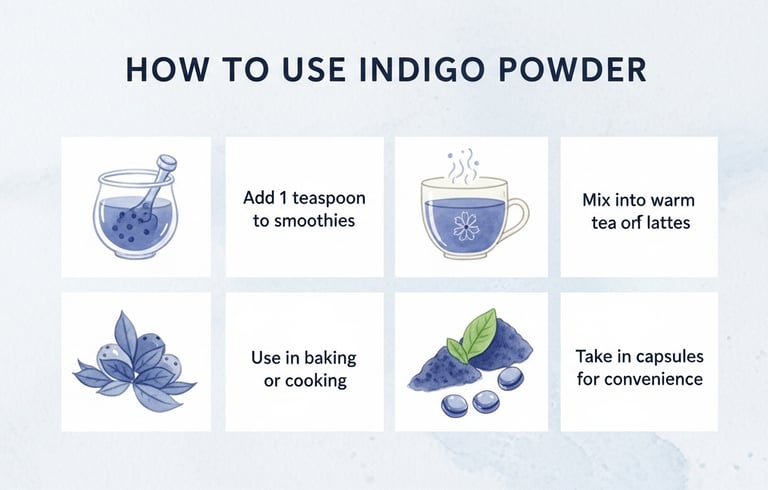
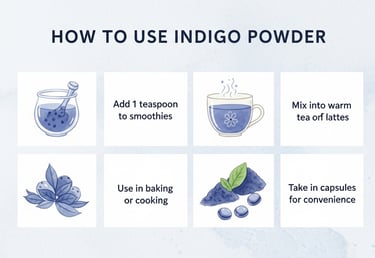
You can enjoy Indigo Powder in many ways:
Dissolve in warm water as a herbal tea
Mix into smoothies, protein shakes, or yogurt
Add to curries, soups, or broths
Place into capsules and swallow
Indigo’s beneficial compounds are heat-stable, so it can be used in cooking.
Q. What benefits can I expect?
Based on traditional use and modern research, indigo may support:
Anti-inflammatory action (tryptanthrin, quercetin)
Strong antioxidant effects (4× more polyphenols than blueberries)
Healthy blood sugar balance
Reduced triglycerides
Improved metabolic response
Skin-calming properties (traditional use: rash, irritation)
These are health-supportive benefits—not medical treatment claims..
Q. How far back does indigo’s history go?
Indigo’s origin reaches back to 3000 BCE (Indus Valley Civilization).
In Japan, indigo spread during the Nara period and became essential for dyeing, medicine, and daily life.
People used to say:
“Indigo merchants never get sick.”
It was carried as a travel remedy and used for fever, detox, and wound care.
Q. How is indigo different from other blue superfoods like spirulina?
Q. How should I store it?
Yes, but begin with a very small amount (just a tiny pinch) and observe their response.
Q. Can children take it?
Keep in a cool, dry, dark place.
After opening, store in an airtight container and consume as soon as possible.
✨Please contact us if you have any questions🥰🙏
Projects
Exploring indigo and other Japanese herbs’ healing potential through research
Herbal Study
Analyzing tade-ai’s antioxidant properties


Wellness Trials
Testing natural remedies for skin and gut health and anti-aging detox
Contact Us
Reach out for questions or collaborations
Imported from Japan, packed in Australia by:
IMAKOKO Herbs
IROHA Indigo TM
FNQueensland
Mullumbimby, Australia
Osaka, Japan
© 2025. All rights reserved.
Subscribe for updates and new products!